A backyard renovation goes one of two ways. Either it follows a plan and comes together in the right order, or it happens in random bursts and ends up costing far more than it should because half of it gets pulled up and redone. The difference is almost entirely in the planning.
You do not need to be a designer to plan well. You just need to make the decisions in the right order. Here is where to start.
Start with how you want to use it, not what you want to build
The most common mistake is jumping straight to features. A deck here, a fire pit there, a veggie patch in the corner. Before any of that, ask how you actually want to use the space.
Do you want to entertain? Do the kids need room to run? Is it just somewhere to sit with a coffee in the morning sun? A space built for entertaining looks nothing like one built for two young kids and a trampoline. Get clear on the use and the features will sort themselves out.
It helps to think a few years ahead too. Little kids grow up, the trampoline goes, and the sandpit becomes wasted space. If you can, design for the next stage as well as this one, so you are not ripping things out in three years. A lawn that suits toddlers now can become an entertaining lawn later without much change.
Walk the yard and note what you are stuck with
Every yard has fixed realities. The slope of the block, where the sun falls, where water runs, the spot the dog has claimed, the neighbour’s window you would rather not look into. Spend a few days noticing these before you design anything.
Pay particular attention to two things in a Sydney backyard. Where does the afternoon sun land in summer, because that is where you will want shade, and where does rainwater go, because drainage problems are the most expensive thing to fix after the fact.
Set a real budget, then add a buffer
This is where people get caught out. Backyard projects almost always cost more than the first guess, because the expensive parts are the ones you cannot see in a photo: drainage, levelling, base preparation, removing the old stuff. Before you fall in love with a design, get a realistic handle on what it will take to budget for the project.
Whatever figure you land on, add 10 to 15 per cent on top for the surprises. Old footings under the lawn, a tree stump that will not budge, drainage that turns out to be worse than it looked. There is almost always something.
Sketch a zoned plan
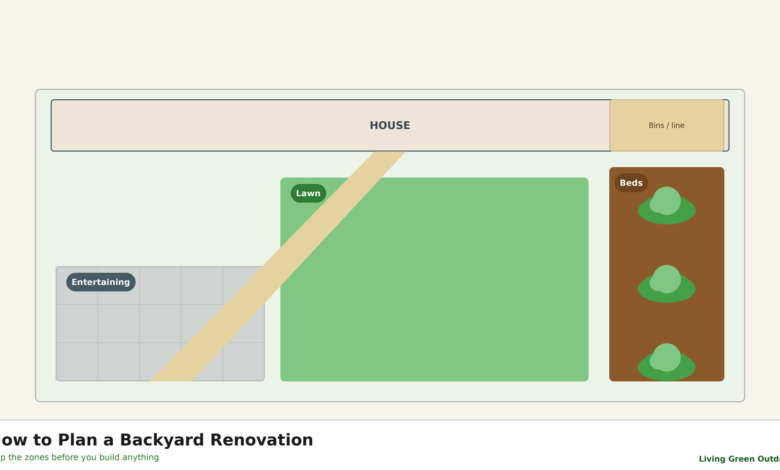
You do not need software. A pencil sketch on paper does the job. Draw the boundary, mark the house, then block out zones: a sitting or dining area, a lawn area, garden beds, a service zone for the bin and the clothesline, and the paths that connect them.
The paths matter more than people expect. Walk the route you actually take across the yard and design the paths to match it, otherwise you end up with a worn track across the lawn that ignores the path you built.
Think about scale while you sketch, too. People consistently undersize entertaining areas. A table for six needs more room than you think once you add chairs you can actually push back and a path to walk around it. Measure your outdoor furniture and draw it to scale on the plan, because a paved area that turns out too small is an expensive thing to redo.
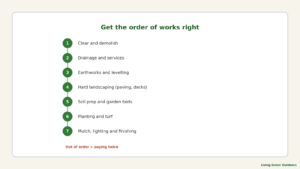
The recommended order of works for a backyard renovation.
Get the order of works right
This is the part that saves the most money. Things have to happen in sequence, because later jobs can undo earlier ones if you go out of order. As a rough guide:
- Demolition and clearing first. Get the old stuff out before anything new goes in.
- Drainage and any plumbing or electrical conduit next, while the ground is open. Burying a drain after you have paved is a nightmare.
- Earthworks and levelling, then retaining walls and any structural work.
- Hard landscaping: paving, decking, paths, edging.
- Soil preparation and garden beds.
- Planting and turf.
- Mulch, lighting and the finishing touches last.
Do these out of order and you will be lifting fresh pavers to run a drain you forgot, or compacting your new soil with a bobcat. The sequence is not fussiness, it is what stops you paying twice.
Check what needs approval before you dig
This is easy to overlook and awkward to fix later. Plenty of garden work needs nothing more than a free weekend, but some of it needs council sign-off. Retaining walls over a certain height, structures near boundaries, decks above a set level, and anything that changes drainage or affects a neighbour can all trigger approval requirements, and they vary by council.
A quick check of your local council’s rules, or a question to whoever you hire, sorts this out before any soil moves. Building first and asking later is how people end up with an order to remove work they have already paid for, which is about the worst outcome a backyard project can have.
Decide what you will DIY and what you will not
Be honest about your skills and your time. Planting, mulching, simple garden beds and basic paths are well within reach for a confident homeowner. Drainage, retaining walls, large paved areas and anything structural are where mistakes get expensive and sometimes dangerous. For those parts it is worth bringing in proper backyard landscaping services rather than learning on the job with a wall that has to hold back a tonne of soil.
Phase it if you need to
Not everyone can do the whole yard at once, and that is fine. The trick is to phase a single plan, not to make it up as you go. Get the full design and the order of works sorted, then tackle it in stages as the budget allows. That way the early stages leave room for the later ones, and nothing has to be undone when you come back to finish.
A sensible way to split it is to do the messy, machinery-heavy work in one hit early, even if you cannot afford the finishing touches yet. Get the drainage, levelling and any hard surfaces done while the site is already torn up, then add planting, lawn and lighting later as funds free up. Bringing the big machines back a second time is where phasing gets expensive, so front-load the heavy stuff.
When to bring in a professional
If the project is large, involves a slope or structural work, or you simply want it done once and done right, getting a quote early is worth it even if you end up doing some of it yourself. A good landscaper will spot the drainage and access issues you would miss, and price the parts that are genuinely hard. There is no harm in reaching out to get a quote and a second opinion before you commit.
The takeaway
Plan the use first, respect the fixed realities of the block, budget with a buffer, and do the works in the right order. Get those four things right and a backyard renovation goes from a money pit to a project that comes together smoothly. Skip the planning and you will learn the order of works the hard way, one redo at a time.
You can also read about: The Future of Fine Jewellery Is Evolving Fast: What to Expect